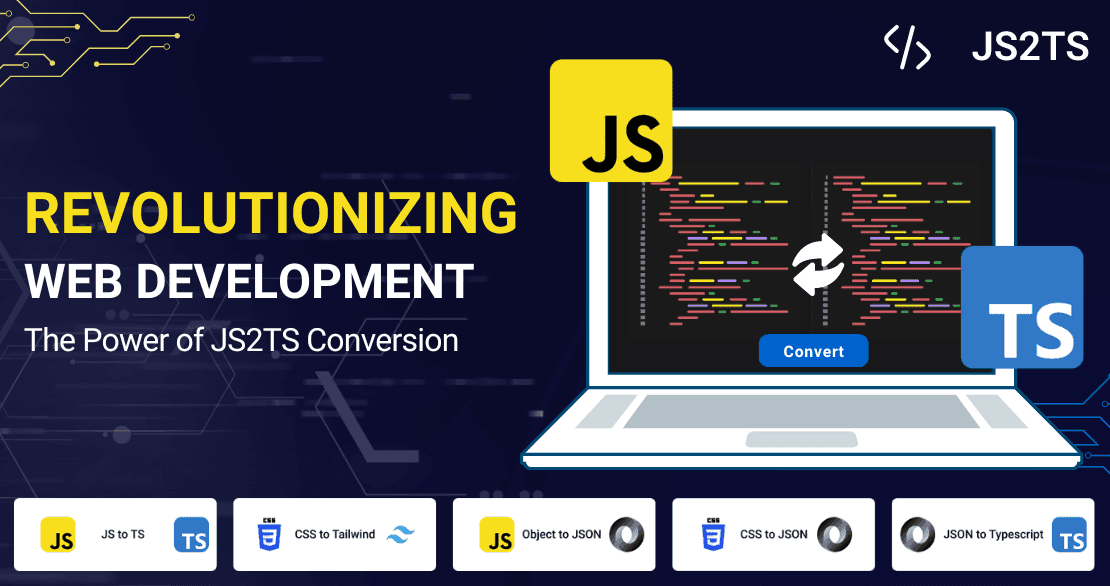

From Code to Data is emerging as a fundamental aspect of web development in the contemporary world, and this is where the role of the JS2TS tool is very crucial in emerging to simplify object serialization. The conversion of JavaScript objects to structured data formats that can be safely consumed by frontend and backend systems can be a challenge to developers.
This is where the JS2TS tool comes in, providing a solution whereby the JavaScript objects and JSON are converted into clean, usable TypeScript definitions, with serialization becoming more speedy and consistent.
Minimizes the use of manual effort in object serialization.
Guarantees formal data integrity.
Enhances the productivity of developers.
Understanding Object Serialization in JavaScript and TypeScript Development
From Code to Data serialization in JavaScript Code to Data serialization This conversion of JavaScript objects to structured data formats, such as JSON, and their reuse by different applications.
The process of serialization of objects gets complicated in case there is a lack or uncertainty of TypeScript types, and that is where the JS2TS tool eases the process.
JavaScript does not have strong typing in objects.
Errors of serialization go up without structure.
TypeScript wants proper typing definitions.
Challenges Developers Face While Converting Code to Structured Data
From-code-to-data conversion can be a problem in cases where developers did not properly tool objects when serializing them manually. These obstacles sluggishly develop and add bugs.
The pain points of serialization are directly resolved by the JS2TS tool that automatizes the object-to-type mappings.
Typesetting production by hand is prone to error.
Unstable object structure brings about bugs.
Validation processes that are time-consuming.
How the JS2TS tool Simplifies Object Serialization from Code to Data
With the built-in (auto) serialization of JavaScript objects or JSON to TypeScript interfaces, from code to data serialization is smooth sailing.
The JS2TS tool removes guesswork, and therefore, the object structure is identical to the original data prior to being serialized.
Such that it is typed automatically in TypeScript.
Has an accuracy of object structure.
Minimizes errors occurring through serialization.
Manual Object Serialization vs JS2TS tool-Based Serialization
Feature | Manual Serialization | JS2TS Serialization |
Type Accuracy | Low | High |
Development Speed | Slow | Fast |
Error Probability | High | Minimal |
Type Consistency | Inconsistent | Consistent |
Using the JS2TS tool for JavaScript Object to TypeScript Conversion
From code to data, workflows become much better when the JavaScript objects are directly transformed into TypeScript definitions by means of the JS2TS tool.
The results obtained by this process facilitate clean serialization through proper typing and reuse of all properties.
Converts JavaScript objects instantly
Supports nested object structures
Improves data reusability
Leveraging JSON to TypeScript Conversion for Clean Data Models
From code to data, serialization is faster when the conversion of the JSON data to TypeScript models is done with the help of the JS2TS tool.
This guarantees no clash between the frontend and backend systems, assuming the same data structure of their systems.
Removes non-congruent types in data.
Improves API data handling
Ensures schema consistency
Benefits of Using the JS2TS tool for Code-to-Data Conversion
Benefit | Impact on Development |
Faster Serialization | Saves development time |
Strong Typing | Reduces runtime errors |
Clean Data Models | Improves maintainability |
Automated Conversion | Eliminates manual work |
Why Choose the JS2TS tool for Simplifying Object Serialization
Code-to-data conversion is trustworthy when the developers decide on using the JS2TS tool to serialize and generate types of objects.
The JS2TS tool does not pay attention to anything but what programmers require—precise JavaScript object and JSON to TypeScript conversion.
Specially designed to be serialized.
Developer-friendly interface
No unnecessary features
From code to data need not be a difficult thing. Using the JS2TS tool, objects can be serialized and TypeScript types can be created in seconds.
Start using the JS2TS tool today to simplify object serialization and eliminate manual type creation.
Faster development cycles
Well-organized and clean data models.
Better TypeScript adoption
Improving Frontend and Backend Consistency with the JS2TS tool
From code to data, consistency is essential in cases of frontend and backend teams in shared object structures.
The JS2TS tool makes sure that both layers are written to the same TypeScript using the direct definitions based on the data in the form of re-serialization.
Reduces data mismatches
Improves team collaboration
Ensures uniform data handling
the JS2TS tool Use Cases in Object Serialization
Use Case | How the JS2TS tool Helps |
API Data Handling | Converts JSON to TypeScript |
Frontend Models | Generates reusable interfaces |
Backend Validation | Ensures structured data |
Object Serialization | Maintains data accuracy |
Conclusion
From code to data transformation is a basic need in the contemporary development, and the JS2TS tool simplifies it, making it accurate and efficient.
The JS2TS tool is useful by automating the serialization of objects and the production of TypeScript, which allows the developer to concentrate on the features instead of resolving the data problems.
Makes objects simpler to serial terminals.
Provides data safety in types.
Saves development time
FAQs:
1. What is the JS2TS tool used for?
To make use of structured data, JavaScript objects and JSON are converted to TypeScript interfaces with the help of the JS2TS tool.
2. What is the role played by the JS2TS tool in serializing objects?
The JS2TS tool will convert the objects of the serialization process correctly to TypeScript types.
3. Does the JS2TS tool support nested objects?
Yes, the JS2TS tool has the structure of complex and nested objects.
4. Can the JS2TS tool be used in frontend development?
Yes, it aids frontend developers in having standard data models.
5. Does the JS2TS tool minimize manual coding?
Yes, it does not require one to manually code TypeScript interfaces.
6. Is it possible to use API data serialization by means of the JS2TS tool?
Yes, it uses API JSON to generate TypeScript types.
7. Is the JS2TS tool beginner-friendly?
Yes, it has an easy and simple interface.
8. Does TypeScript have a best practice in the JS2TS tool?
Yes, it builds structured TypeScript definitions that are clean.
9. Will the JS2TS tool enhance the consistency in data?
Yes, it guarantees uniformity in the object structures with respect to applications.
10. Why is the JS2TS tool important for code-to-data conversion?
The JS2TS tool eases the whole procedure of transforming the code items into structured information, which is type-safe.